Want to know how to get cited in Google AI Overviews? Google’s own answer is less exciting than most advice online: there is no special trick. To be shown as a source in AI Overviews or AI Mode, a page must be indexed and eligible to appear in Search with a snippet. Google says there are no additional requirements and no special optimizations necessary. What earns the citation is ordinary SEO done well, plus content that adds something other pages don’t.
That is good news for businesses, because it means the work is clear. This guide covers what Google has published about how its AI features choose sources, what helps, the shortcuts Google says you can skip, how to control what is shown and how to measure your AI visibility in Search Console. Every point comes from Google’s AI features documentation and its newer guide to optimizing for generative AI search.
- A page needs to be indexed and snippet eligible. Google lists no other technical requirements.
- AI features run several related searches at once, so pages that answer the sub-questions get used.
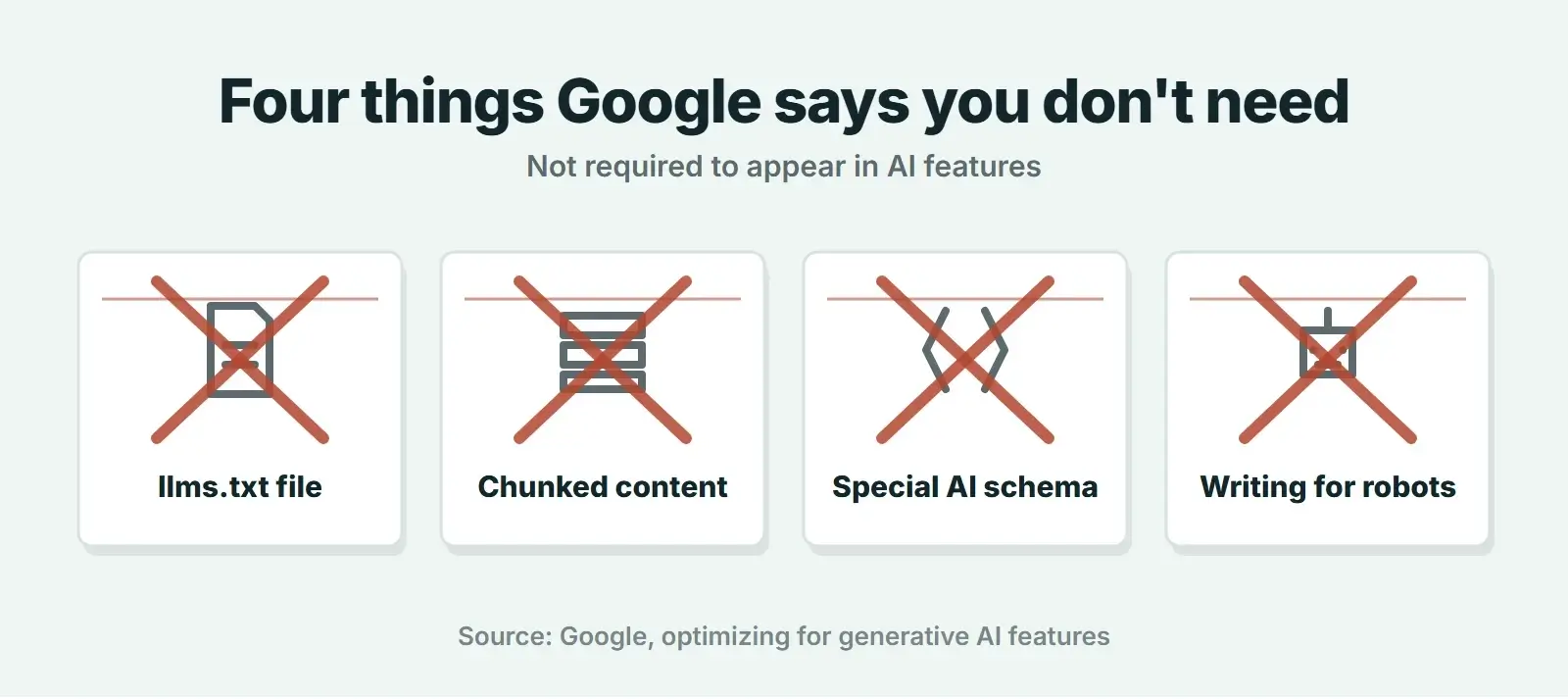
- Google says you don’t need llms.txt, chunked content, special schema or AI-only writing.
- Non-commodity content, with first-hand experience and specific detail, gives Google a reason to cite you.
- Search Console’s Generative AI performance report shows your AI impressions by page, country and device.
What are AI Overviews and AI Mode?
AI Overviews are the AI-generated summaries that appear at the top of some Google results, with links to the pages they draw from. AI Mode is a separate, conversational search experience where people ask longer questions and follow-ups. Both are built on Google’s core Search systems, and both link out to supporting pages. Those links are the citations this guide is about.
| AI Overviews | AI Mode | |
|---|---|---|
| Where it appears | At the top of a normal results page, for some searches | A separate search mode |
| What people do | Read a quick summary, then click or keep scrolling | Ask detailed questions and follow-ups |
| How sources show | Links alongside the summary | Links within and beside the answer |
| Eligibility for your page | Indexed and snippet eligible | Indexed and snippet eligible |
| Reported in Search Console | Performance and Generative AI reports | Performance and Generative AI reports |
What it takes to be cited in AI Overviews
Google’s AI features page sets out the requirement in one sentence: to be eligible as a supporting link, a page must be indexed and eligible to be shown in Google Search with a snippet. It adds that there are no additional technical requirements.
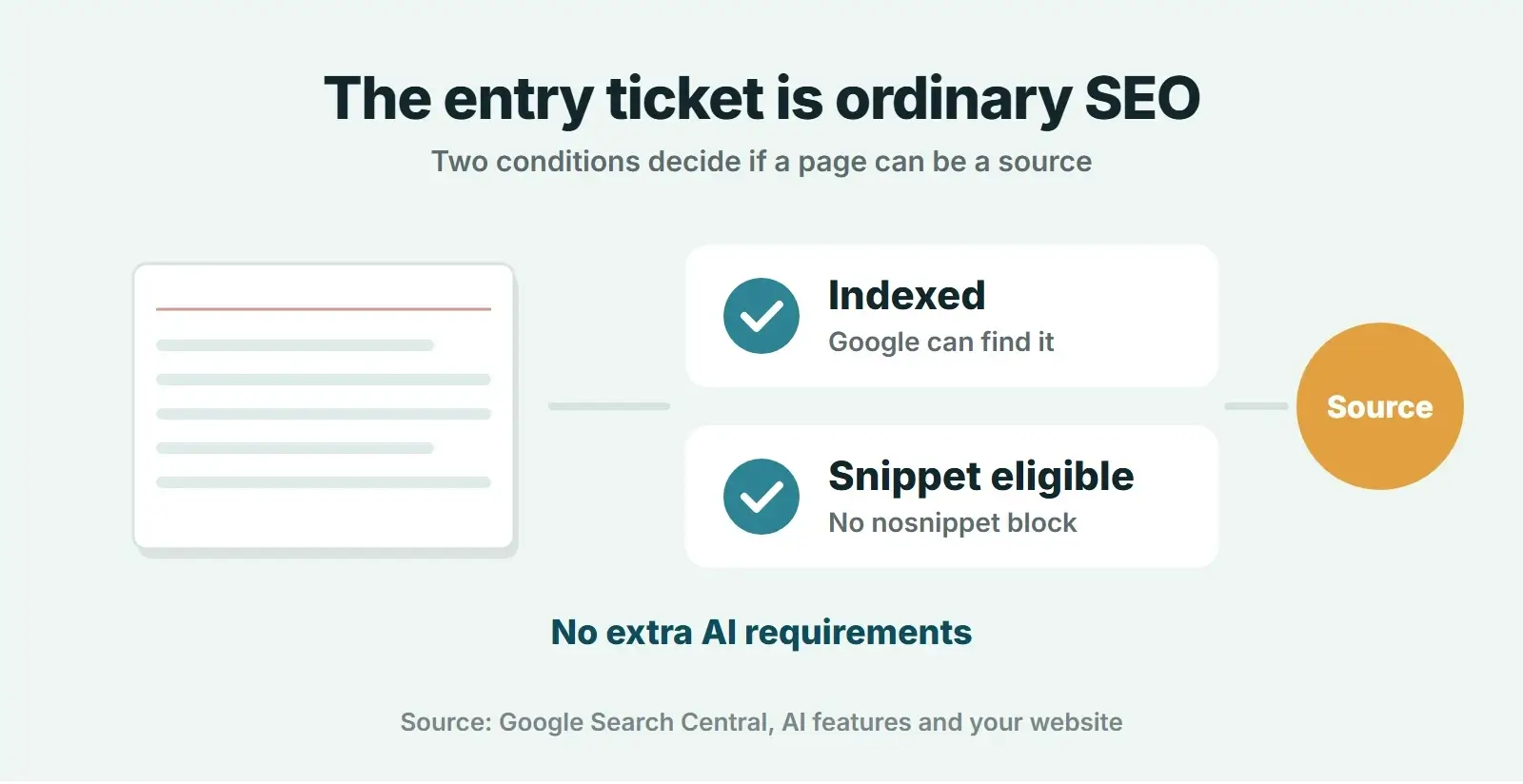
Being eligible is not the same as being chosen, of course. Google picks sources the way it ranks pages: on relevance and quality. So the practical question becomes which of your pages are good enough to be the best answer to part of a question. Google’s list of best practices for AI features is the same list it gives for Search in general:
- Allow crawling in robots.txt and make sure your CDN or hosting does not block Googlebot.
- Link to important pages from other pages on your site, so they are easy to find.
- Give visitors a good page experience on every device.
- Put important content in text, not only in images or video.
- Support the text with good images and video where they help.
- Make sure structured data matches the visible text on the page.
- Keep your Merchant Center and Google Business Profile information up to date.
If any item on that list is weak, fix it first. A page blocked by a CDN rule, hidden behind a script or marked nosnippet cannot be cited, however good it is. A technical SEO check catches these problems quickly.
How query fan-out picks your page
The most useful idea in Google’s documentation is query fan-out. Google says AI Overviews and AI Mode may issue multiple related searches across subtopics and data sources to build a response. One question from a user can become a handful of searches behind the scenes.
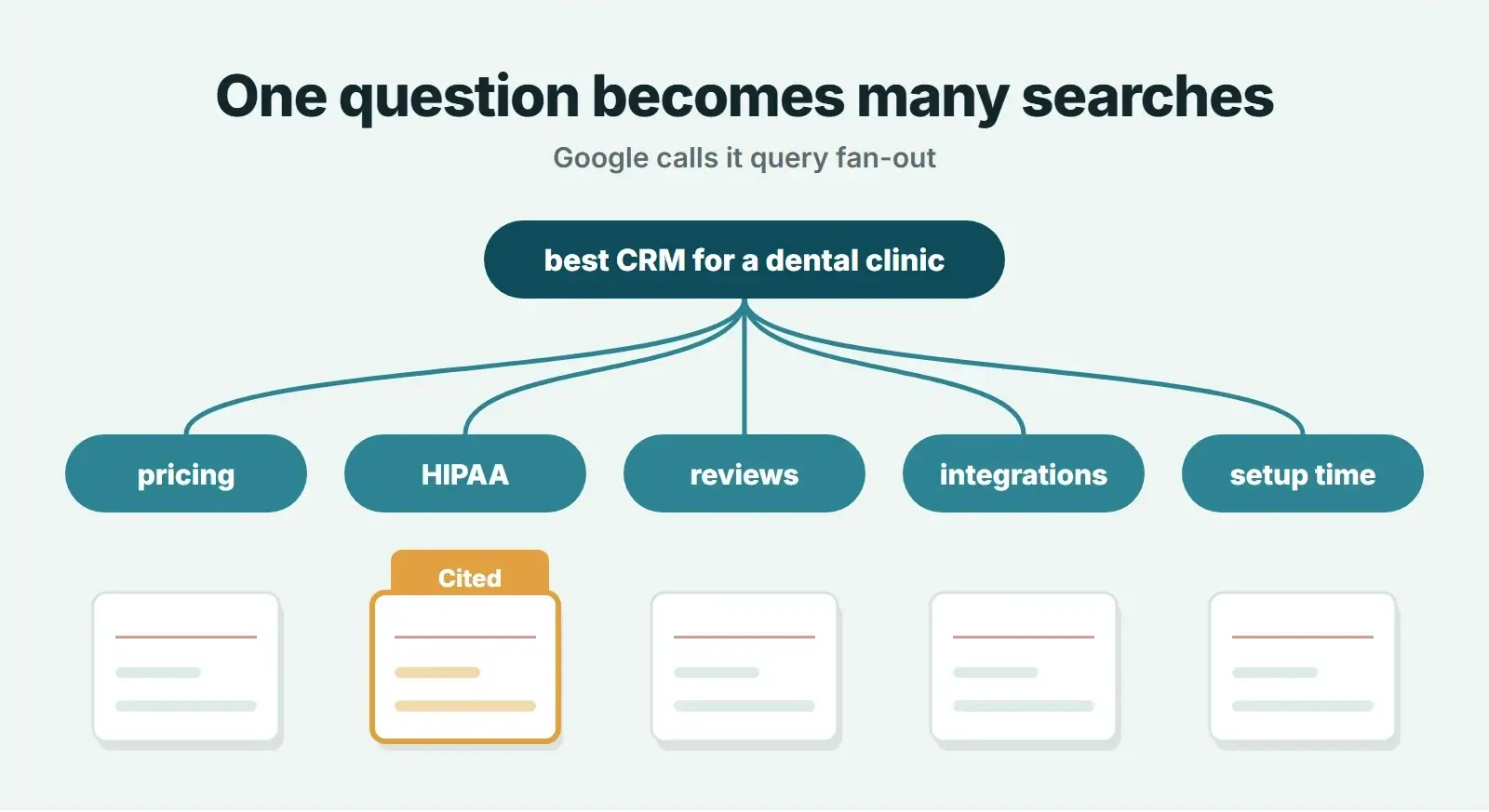
This changes how to think about getting cited. You don’t need to win the whole question. A page that answers one sub-question clearly and better than anyone else, such as how a product handles patient data, can be the source for that part of the answer. In practice, that means:
- Cover the questions buyers actually ask, including the specific ones: price ranges, requirements, comparisons, steps and edge cases.
- Answer each one directly, near the top of its section, then add the detail.
- Use clear headings, so each answer is easy to find on the page.
- Link related pages together, so Google can see the full depth of what you cover.
Myths: what Google says you don’t need to do
A lot of AI search advice sells new tactics. Google’s 2026 guide has a section devoted to busting them, and it says AEO and GEO are still SEO from Google’s point of view. These are the shortcuts it lists as unnecessary:
| Myth | What Google says |
|---|---|
| You need an llms.txt or AI text file | You don’t need new machine readable files, AI text files, markup or Markdown. Google Search ignores these files. |
| Break content into small chunks | There’s no requirement to break content into tiny pieces, and no ideal page length. |
| Write a special way for AI | You don’t need to write in a specific way for generative AI search. It understands synonyms and meaning. |
| Add special schema for AI | There’s no special schema.org markup you need to add. Structured data still helps rich results. |
| Get mentioned everywhere | Seeking inauthentic mentions across the web isn’t as helpful as it might seem. |
One more warning from the same guide matters for anyone tempted to scale up: creating many pages for small query variations to manipulate rankings counts as scaled content abuse under Google’s spam policies. More pages is not the answer. Better pages are. Google also notes that no third-party tool has access to its internal ranking or AI systems, so treat any tool that promises to predict AI citations with care.
Write non-commodity content
If eligibility is ordinary SEO, the real difference between pages is what they add. Google’s guide asks for valuable, non-commodity content with a unique viewpoint, such as first-hand experience, rather than a restatement of what already exists. When ten pages say the same thing, Google has no reason to cite yours.
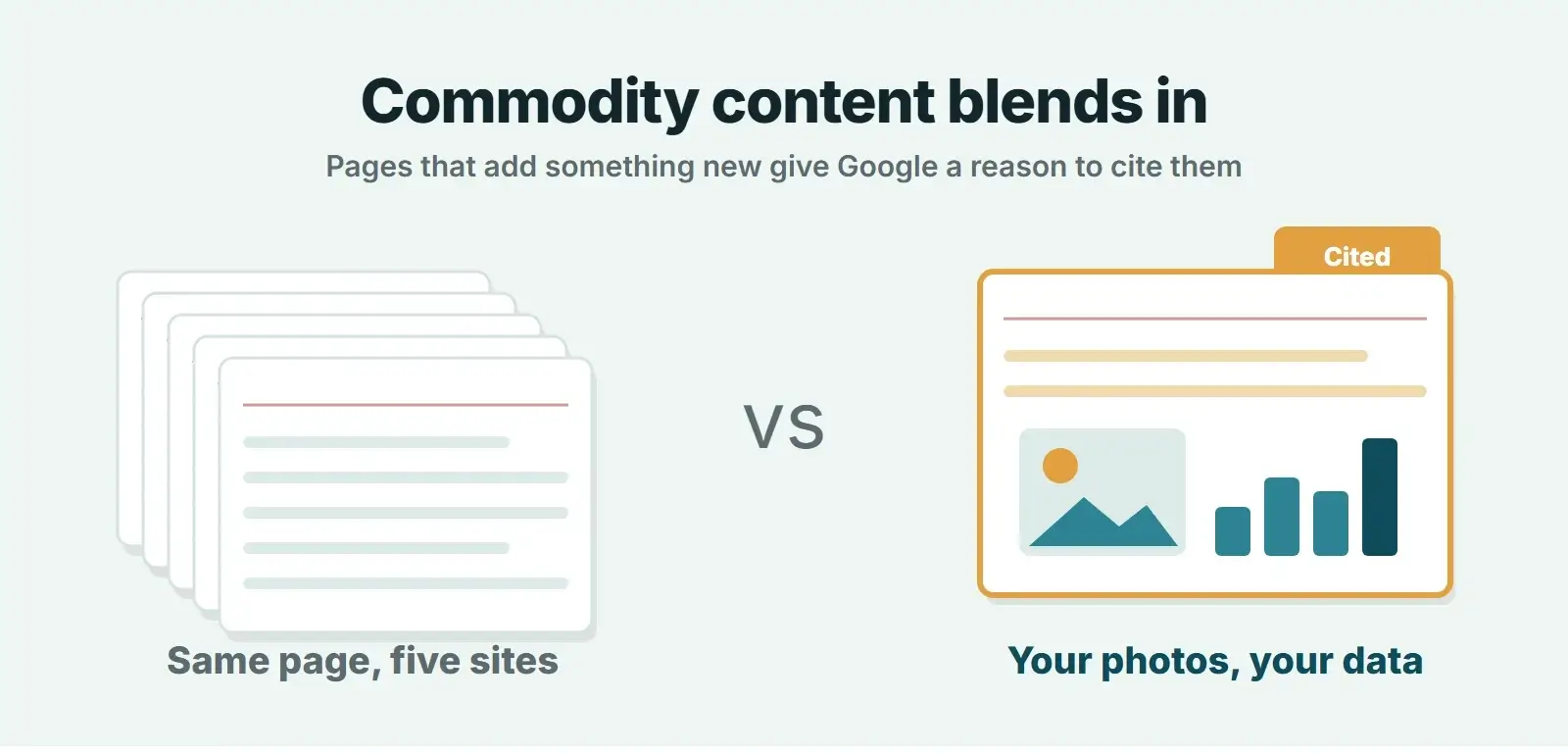
Ways to make a page non-commodity:
- Show your own experience: what you saw on real projects, with the details that only someone who did the work would know.
- Publish your own numbers: survey results, price ranges you actually quote, timings from your own work.
- Explain trade-offs honestly: when an option is a bad fit, and why.
- Use original images: your own photos, diagrams and screenshots, not stock.
- Keep facts current: date the page and update it when the facts change.
For local businesses and stores, two more sources feed AI answers directly. Google says to keep your Business Profile and Merchant Center data current, and our Google Business Profile guide covers the profile side.
Technical checks that block AI citations
Google’s 2025 advice on AI experiences also highlighted page experience: whether a page displays well on every device, how fast it loads and whether visitors can tell the main content apart from everything else. Our Core Web Vitals guide covers the speed side. The technical problems we see most often on pages that should be cited but aren’t:
- Googlebot blocked by robots.txt, a firewall, a CDN rule or a bot protection setting.
- Key content loaded only by JavaScript that Google struggles to render.
- A nosnippet or max-snippet tag added by a plugin or theme without anyone noticing.
- Answers locked inside images, PDFs or tabs that hold no real text.
- Structured data that says something different from the visible page.
- Important pages with no internal links pointing to them.
- Duplicate versions of the same page competing with each other.
Structured data deserves a note. It does not create AI citations on its own, and Google says no special schema is needed. But accurate schema markup still helps Google understand who you are and what a page is about, which is why we treat it as part of schema and entity optimization rather than an AI hack.
Control what Google shows from your pages
Some businesses want the opposite: to limit what AI features show. Google applies the same controls as normal snippets. You can use nosnippet, data-nosnippet, max-snippet or noindex to limit the information shown from your pages in Search.
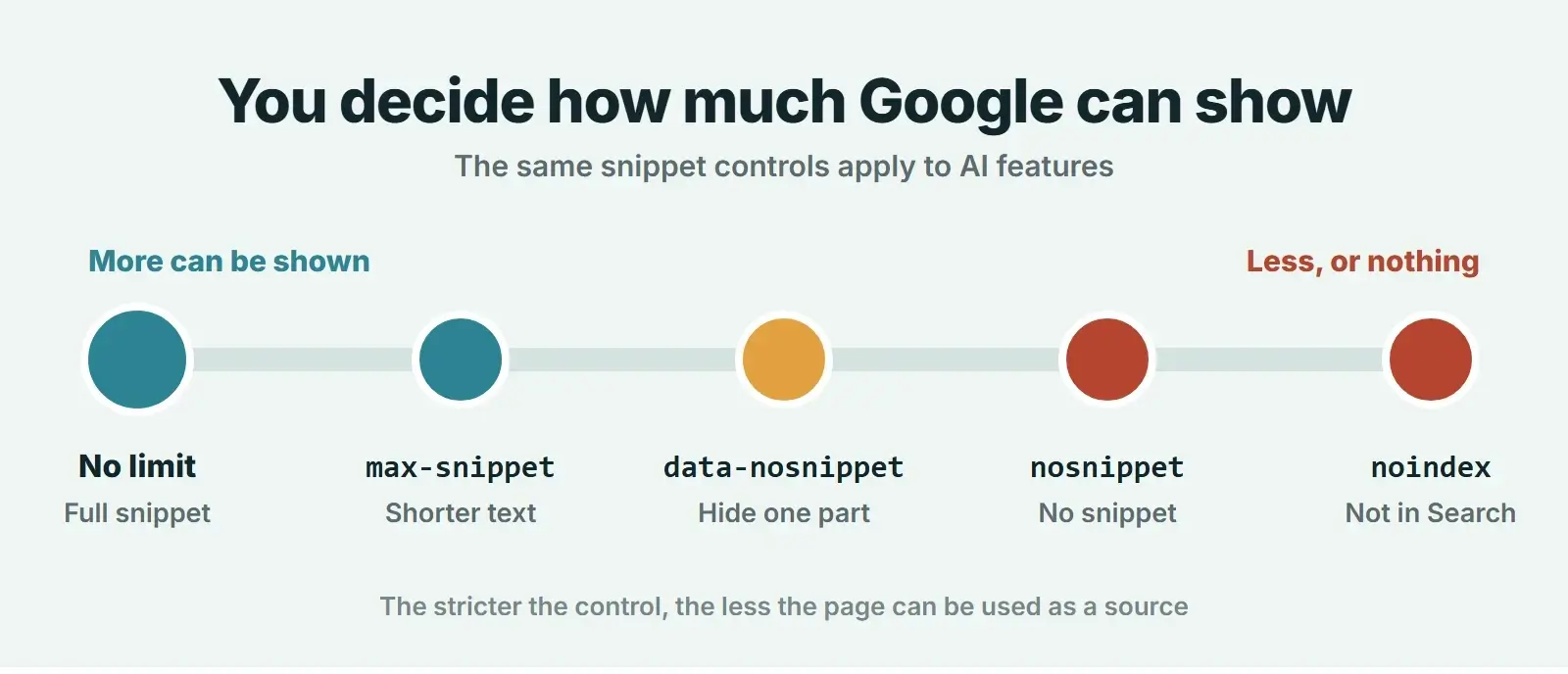
Be careful with these. The stricter controls also stop the page from being a cited source. If you want visibility in AI answers, use data-nosnippet only on parts you really need to keep out, such as a members-only price or legal small print.
How to measure your AI visibility in Search Console
For a long time there was no official way to see AI Overviews traffic. That changed in 2026. Search Console now has a Generative AI performance report that shows how many times links to your site were shown in a generative AI feature on Google Search. It covers AI Overviews and AI Mode, and Google says that as of August 31, 2026, it has rolled out to all websites worldwide.
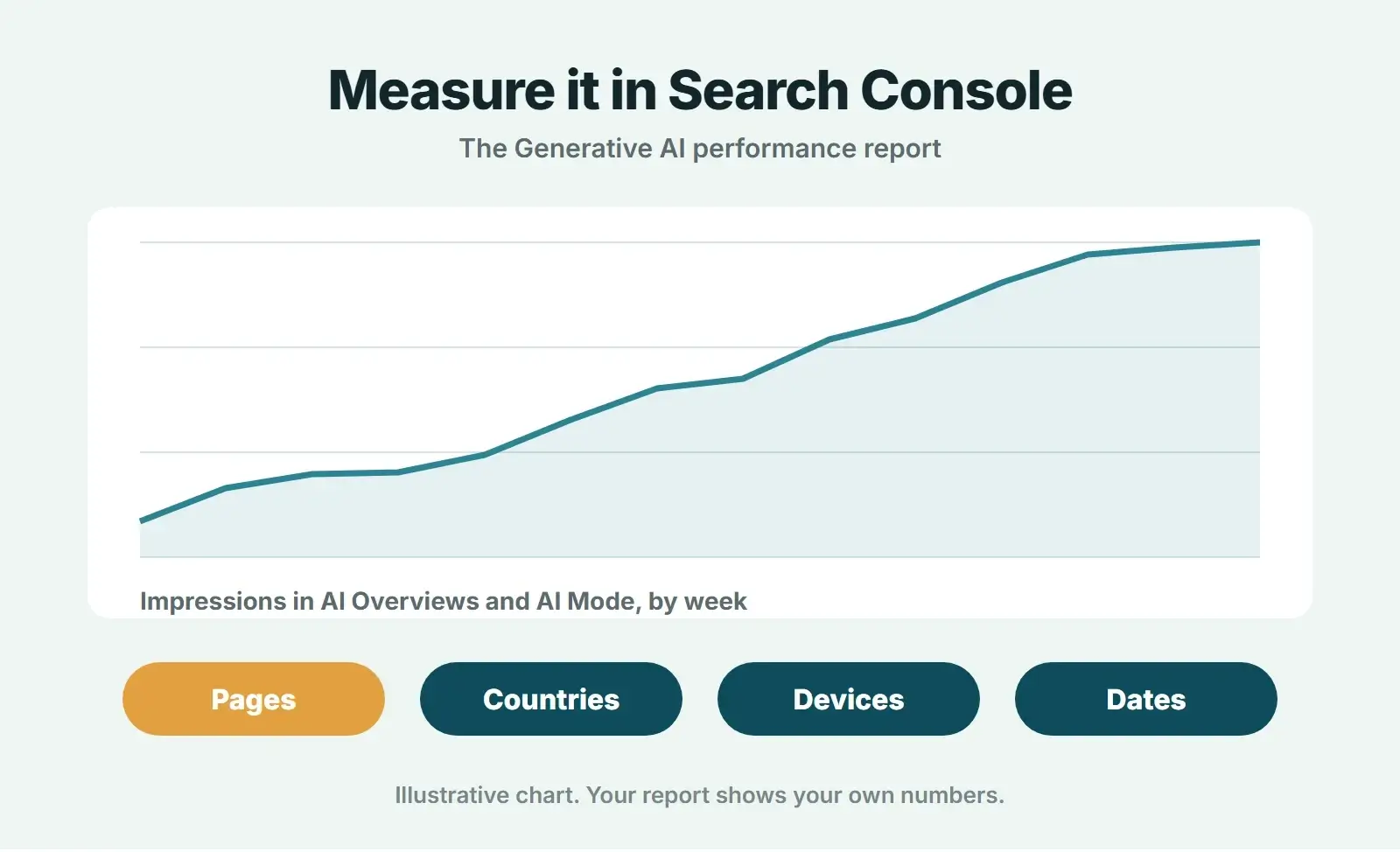
- Find your cited pages: sort by pages to see which URLs are shown most and least.
- Compare markets: group by country if you sell in more than one.
- Track change over time: compare weeks or months after you update content.
- Check clicks in the Performance report: Google counts traffic from AI features in the main Performance report under the Web search type.
The report may be empty if your site has very few AI impressions, or if the site has been excluded from Search generative AI features in Search Console settings. Outside Google, other assistants such as ChatGPT and Perplexity need their own tracking, which is what our AI visibility tracking service does.
Want your business cited in AI answers?
We audit how AI assistants, including Google’s AI Overviews, describe and cite your brand, fix the technical and content gaps, and track your visibility over time.
Frequently asked questions
How do I get cited in Google AI Overviews?
Make sure the page is indexed and eligible to show a snippet, then make it the clearest, most useful answer to a specific question. Google lists no extra requirements for AI Overviews. Cover the sub-questions buyers ask, add first-hand detail and fix any crawling or rendering problems.
How do I get mentioned in AI Mode?
AI Mode uses the same eligibility rules as AI Overviews: an indexed page that can show a snippet. Because AI Mode handles longer, follow-up questions, in-depth pages that answer related questions in one place tend to be useful sources. Keep your Business Profile and product data current too.
Do I need llms.txt to appear in AI Overviews?
No. Google’s guide says you don’t need new machine readable files, AI text files, markup or Markdown to appear in Google Search, and that Google Search ignores these files. Other AI companies may treat them differently, but they are not needed for Google.
Can I see AI Overviews traffic in Search Console?
Yes. The Generative AI performance report shows impressions in AI Overviews and AI Mode by page, country, device and date, and Google says it reached all websites by August 31, 2026. Traffic from AI features is also included in the main Performance report under Web search.
How do I stop Google using my content in AI Overviews?
Use the standard snippet controls. data-nosnippet hides part of a page, nosnippet removes the snippet and noindex removes the page from Search. Each one also limits whether the page can be a cited source, so use the lightest control that meets your need.
Final thoughts
The honest answer to how to get cited in AI Overviews is to be the best source for something specific. Keep pages indexed and snippet eligible, answer the sub-questions buyers ask, add what only you know and measure the result in Search Console. Skip the shortcuts Google has already called unnecessary. If you want the wider picture across ChatGPT, Gemini and Perplexity, start with our guide to generative engine optimization, or ask our team about AI visibility optimization for your site.