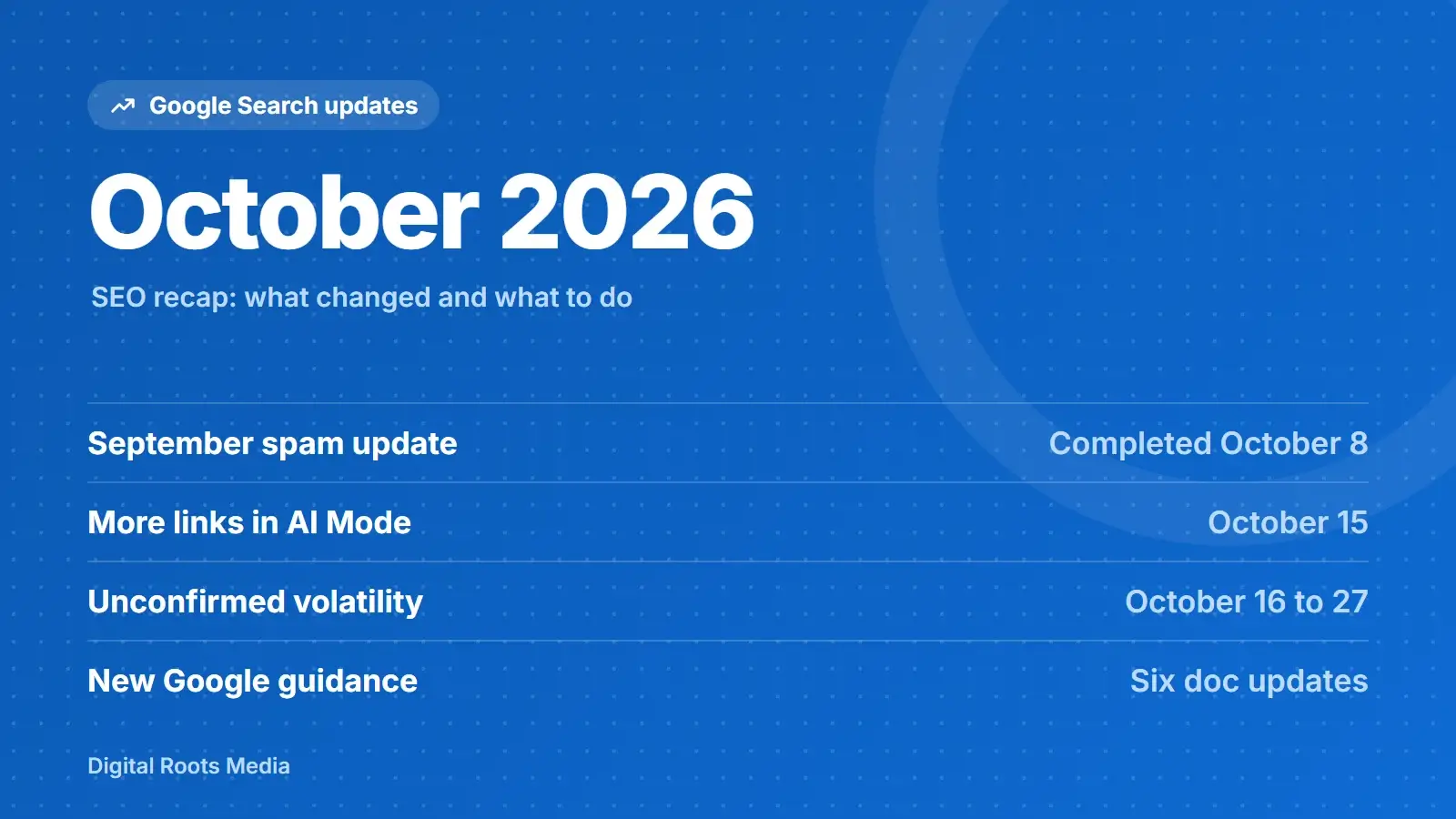
- The September 2026 spam update finished on October 8, two weeks after it started.
- Google confirmed no new ranking update in October up to October 27, when this recap was written, but trackers reported several waves of unconfirmed volatility.
- On October 15, Google added more links to AI Mode and AI Overviews and began testing a section that highlights official websites.
- Google updated its generative AI content guide on October 1 with references to the Search Quality Rater Guidelines.
- New documentation covers the Search generative AI control, hyphens in URLs, the Indexing API quota and user-generated spam.
SEO updates in October 2026 came without a headline ranking update. The September spam update finished early in the month, rankings then moved repeatedly without any confirmation from Google, and Google spent the rest of October changing how AI answers send people to websites and tidying up its documentation. Several of those changes matter for any business that wants to be found in Google Search.
Here is what Google confirmed in October 2026 and what to do about it. For the previous month, see our September 2026 SEO updates recap.
October 2026 at a Glance
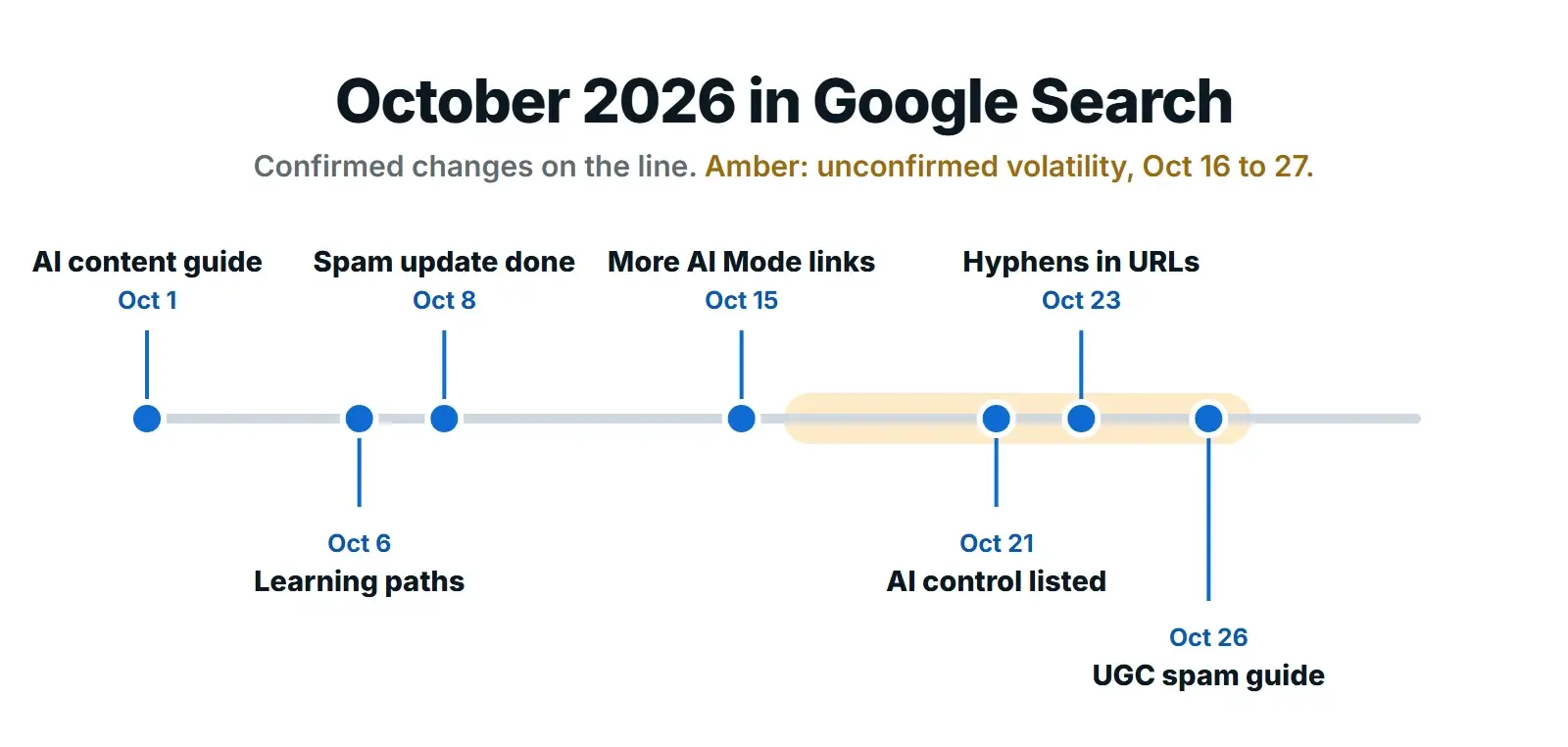
- October 1: Google updates its guide to using generative AI content.
- October 6: Google publishes two SEO learning paths on YouTube.
- October 8: The September 2026 spam update completes. Google documents the UGC Fresh Data Program.
- October 15: Google announces more links in AI Mode and AI Overviews.
- October 16: Google updates its Indexing API quota page. Unconfirmed volatility is reported.
- October 20 to 21, 24 and 27: More unconfirmed volatility is reported.
- October 21: Google’s page on controlling what you share now lists the Search generative AI control.
- October 23: Google clarifies hyphens versus underscores in URLs.
- October 26: Google updates its guidance on preventing user-generated spam.
1. The September 2026 Spam Update Finished on October 8
Google’s Search Status Dashboard confirms that the September 2026 spam update, which started on September 24, ended on October 8. Google’s note reads: “The rollout was complete as of October 8, 2026.” That is the full two weeks Google allowed, much longer than the June and August spam updates, which each finished in a few days.
Now that it has finished, you can measure it properly. Compare your Search Console clicks and impressions from the two weeks before September 24 with the two weeks after October 8. If traffic dropped and stayed down, check Manual actions in Search Console and review Google’s spam policies, especially scaled content abuse, site reputation abuse, expired domain abuse and link spam.
2. Unconfirmed Ranking Volatility, but No Google Update
Google’s dashboard lists no new ranking update in October, but rankings did not sit still. Search Engine Roundtable reported spikes in volatility and SEO chatter around October 16, October 20 and 21, October 24 and again on October 27, and noted that Google had not confirmed anything. It also said third-party rank trackers were struggling to track the movement, so their charts may disagree.
Many SEOs expected a core update by now. The last one, the May 2026 core update, finished on June 2, and we looked at the timing in our post on when the next Google core update may arrive. Until Google confirms an update, treat October’s movement as something to watch, not a reason to rewrite pages.
What to do
- Annotate the dates (October 16, 20 to 21, 24 and 27) so you can match them against your own data later.
- Look at pages, not totals. If only a few pages moved, check whether competitors published something better for those searches.
- Do not rewrite in a panic. Pages that were never broken can be made worse by hasty changes.
3. More Links in AI Mode and AI Overviews
On October 15, Google announced a set of changes to AI Mode and AI Overviews that give people more ways to click through to websites. Hema Budaraju, VP of Product Management at Google, wrote that Google has made continued and substantial increases to inline links and is launching updates to show them higher in responses more often.
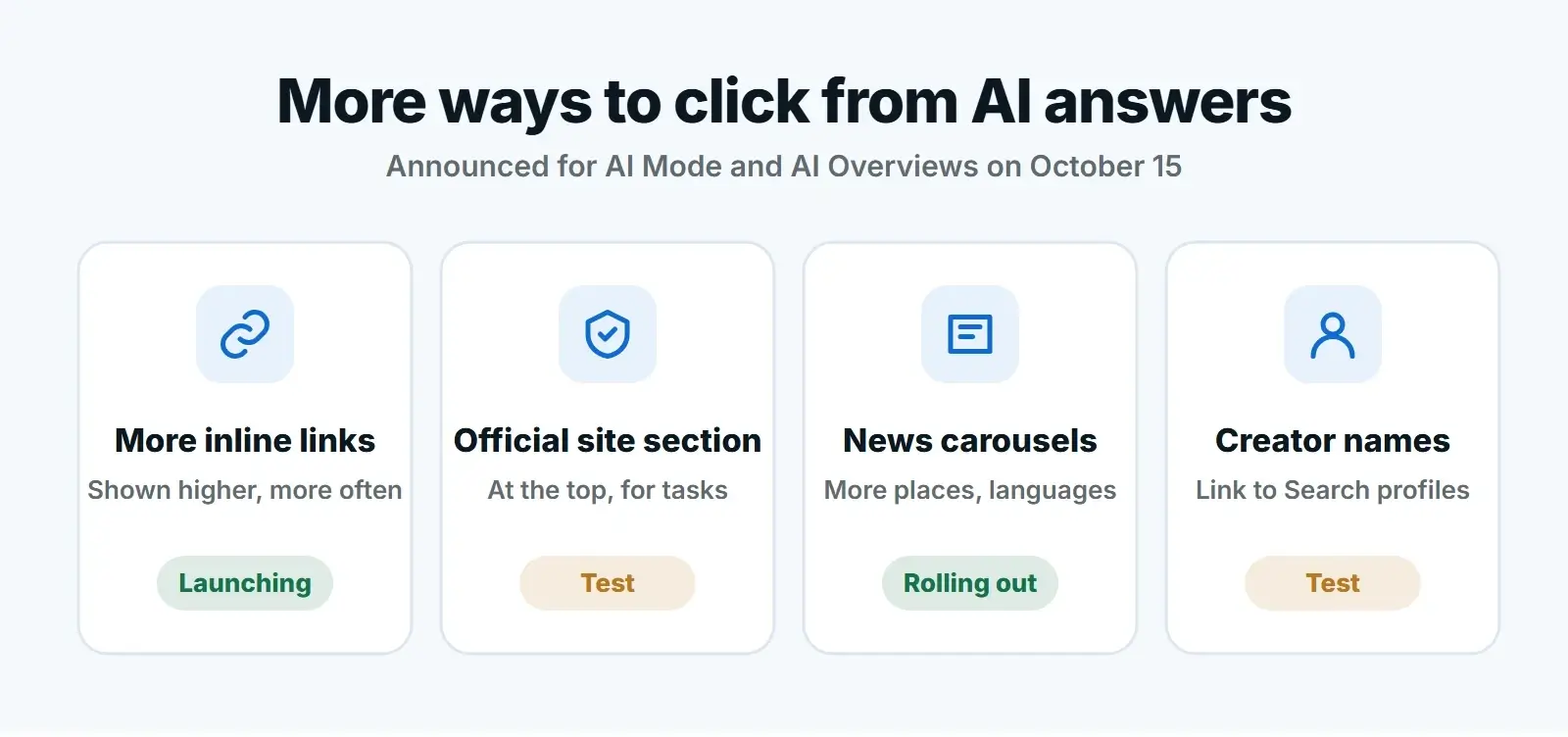
- More inline links, shown higher and more often in AI responses.
- An official website section. Google will test a section at the top of AI responses that highlights the official page when someone wants to complete a task, with context on why each link is useful.
- News carousels for timely articles are rolling out to more locations and languages, and they highlight each user’s Preferred Sources.
- Related article links at the end of some responses get image thumbnails and a more clickable design.
- Creator and publisher names on video results in AI Mode will link to their Search profiles. Google started testing this in the week of the announcement.
“We’ll be testing a new display in Search AI experiences to prominently surface these links”
Google also said use of Preferred Sources has grown by more than 7x since the start of the year.
For businesses, the official website test is the one to watch. When someone wants to book, buy or contact a specific business, Google wants to send them to the official page. Make sure your booking, contact and service pages are easy to find, clearly named and linked from your Google Business Profile. Our guide to generative engine optimization covers how to get cited in AI answers, and our AI visibility optimization service can track and improve it for you.
4. Google Updated Its Guide to AI-Generated Content
On October 1, Google updated its guide to using generative AI content with information from the Search Quality Rater Guidelines. The guide now points to the rater guideline sections on scaled content abuse (section 4.6.5) and on main content made with little to no effort, originality or added value (section 4.6.6). Google is careful to add that the rater guidelines are not a guide to ranking and that raters do not directly influence rankings.
The guide also asks creators to fact-check and review everything AI produces before publishing, including titles, meta descriptions, structured data and image alt text. As Google puts it, generative models “don’t retrieve facts, but predict a likely sequence of words based on their training data.”
On the same day, Google rewrote its helpful content guidance to define main content, list four quality attributes and call fake author profiles a form of deception. We covered that change in detail in our next core update post. If you publish AI-assisted content, our guide to AI content and Google penalties explains where the line is.
5. The Search Generative AI Control Is Now Documented
On October 21, Google updated its page on controlling what you share with Google Search to list every option in one place: deleting or password-protecting content, noindex, robots.txt, the robots meta tag, data-nosnippet, X-Robots-Tag and the Search generative AI control. Google describes that control as a way to manage your site’s inclusion in generative AI features on Google Search, including AI Overviews and AI Mode, and it is set in Search Console.
For most businesses the right setting is to stay included. AI Overviews and AI Mode are where more and more searches start, and Google is adding links to them, as shown above. Leaving them should be a deliberate decision, not a reaction to a traffic dip.
6. Technical SEO: Hyphens, the Indexing API and User-Generated Spam
Use hyphens in URLs
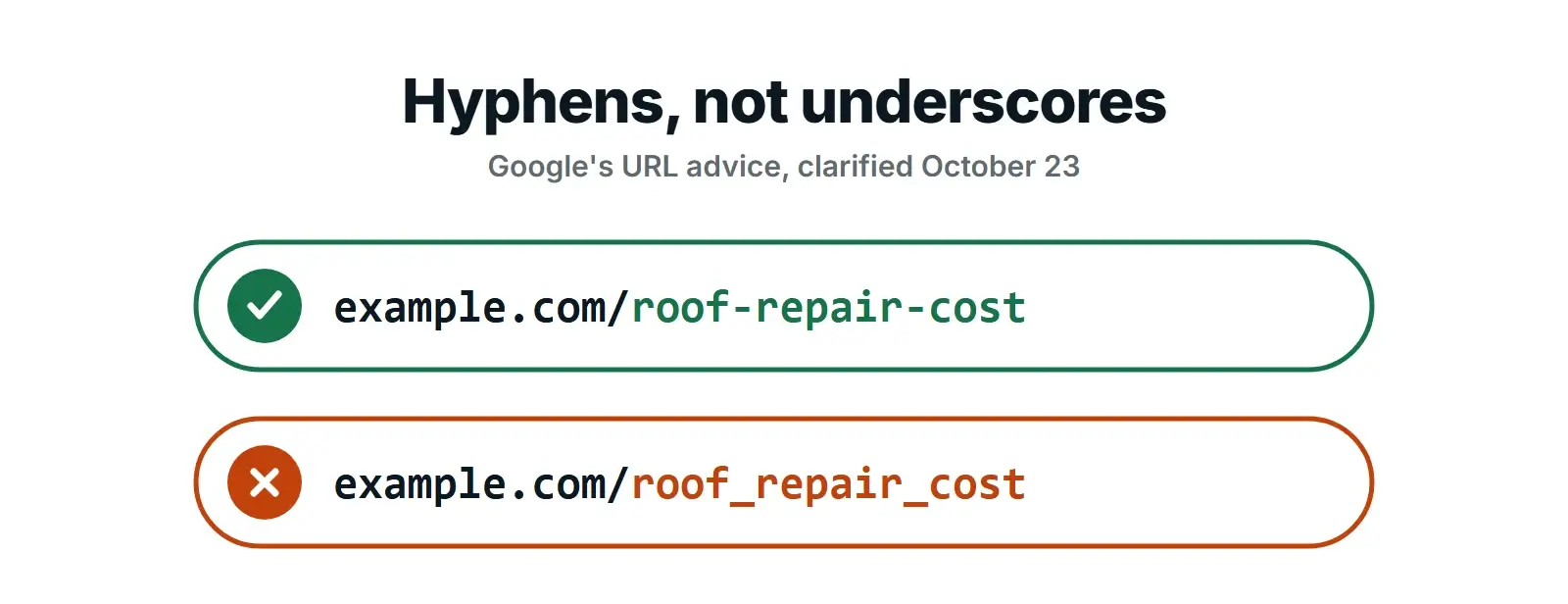
On October 23, Google clarified its URL structure guidance: “we recommend using hyphens (-) instead of underscores (_) to separate words in your URLs.” Hyphens clearly mark where one word ends, while underscores are often used in code to join words together. If your existing URLs use underscores, do not rush to change them. Changing URLs needs 301 redirects and carries its own risk. Use hyphens for new pages.
The Indexing API quota page
On October 16, Google updated its Indexing API quota page to show the current limits: 200 publish requests a day per project, 180 metadata requests a minute and 380 requests a minute across all endpoints. The daily quota resets at midnight Pacific Time. Google also removed an outdated form.
User-generated content: spam and freshness
On October 26, Google updated its guide to preventing user-generated spam. Pages created for direct sharing, collaboration or utility, rather than for search, should be kept out of the index by default with noindex or robots.txt. Google also recommends verifying your site in Search Console for alerts and watching for unexpected spikes in indexed pages, impressions or unrelated queries.
On October 8, Google documented the UGC Fresh Data Program, a dedicated pipeline for trending user-generated content from large forums and social platforms. It is application only, for high-volume platforms that meet strict technical and moderation criteria. Most business websites will not need it.
7. Free SEO Training From Google
On October 6, Google’s Daniel Waisberg announced two SEO learning paths on the Search Central YouTube channel: Search fundamentals for beginners, covering how Search works, Search Console and Google Trends, and Technical SEO fundamentals, covering crawling, indexing, rendering and debugging at scale. If someone on your team looks after your website, the beginners’ playlist is a useful place to start.
8. Your November Action Plan
- Compare Search Console data from before September 24 with the weeks after October 8
- Annotate the October volatility dates and watch for a confirmed core update
- Make your booking, contact and service pages easy for Google to identify as official
- Fact-check every AI-assisted page, including titles, meta descriptions and alt text
- Check the Search generative AI setting in Search Console is what you intend
- Use hyphens in every new URL, and keep old URLs unless you can redirect them
9. Frequently Asked Questions
Was there a Google update in October 2026?
Google confirmed no new ranking update in October 2026 up to October 27, when this recap was written. The September 2026 spam update finished on October 8. Search Engine Roundtable reported unconfirmed volatility around October 16, October 20 and 21, October 24 and October 27.
When did the September 2026 spam update finish?
Google’s Search Status Dashboard says the rollout was complete as of October 8, 2026. It started on September 24, so it took two weeks, the full window Google had allowed.
What changed in AI Mode in October 2026?
On October 15, Google announced more inline links shown higher in responses, a test of a section that highlights official websites, news carousels in more locations and languages, thumbnails on related article links and a test of clickable creator names on AI Mode video results.
Should I use hyphens or underscores in URLs?
Hyphens. Google’s URL guidance, clarified on October 23, recommends hyphens instead of underscores to separate words. Use hyphens for new pages, but do not change existing URLs without 301 redirects.
Can I keep my site out of AI Overviews and AI Mode?
Yes. Google’s documentation lists a Search generative AI control in Search Console that manages your site’s inclusion in generative AI features, including AI Overviews and AI Mode. For most businesses, staying included is the better choice.
Final Thoughts
October brought no confirmed ranking update, but it showed where Google Search is going. AI answers are getting more links and a dedicated place for official websites, and Google’s guidance keeps raising the bar on effort, originality and honesty. The sites that do well are the ones that are clearly the best answer, and clearly the official source for what they offer.
At Digital Roots Media, our SEO and technical SEO teams help businesses grow through every update. Our technical SEO audit guide shows what to check first, or request a free website audit and we will show you what to fix.