The Google algorithm is not one formula. It is a collection of automated ranking systems that look at hundreds of billions of pages and decide which ones best answer a search. Google first has to find and store a page (crawling and indexing); then its ranking systems weigh relevance, quality, usability and spam signals to order the results. Understanding those stages tells you where to focus, and which popular “ranking factors” you can safely ignore.
- Search has three stages: crawling, indexing, and ranking and serving.
- Ranking is done by many systems at once, covering relevance, quality, usability and spam.
- Core updates retune those systems several times a year; spam updates target policy violations.
- Word counts, keyword density and posting frequency are not ranking factors.
The three stages of Google Search
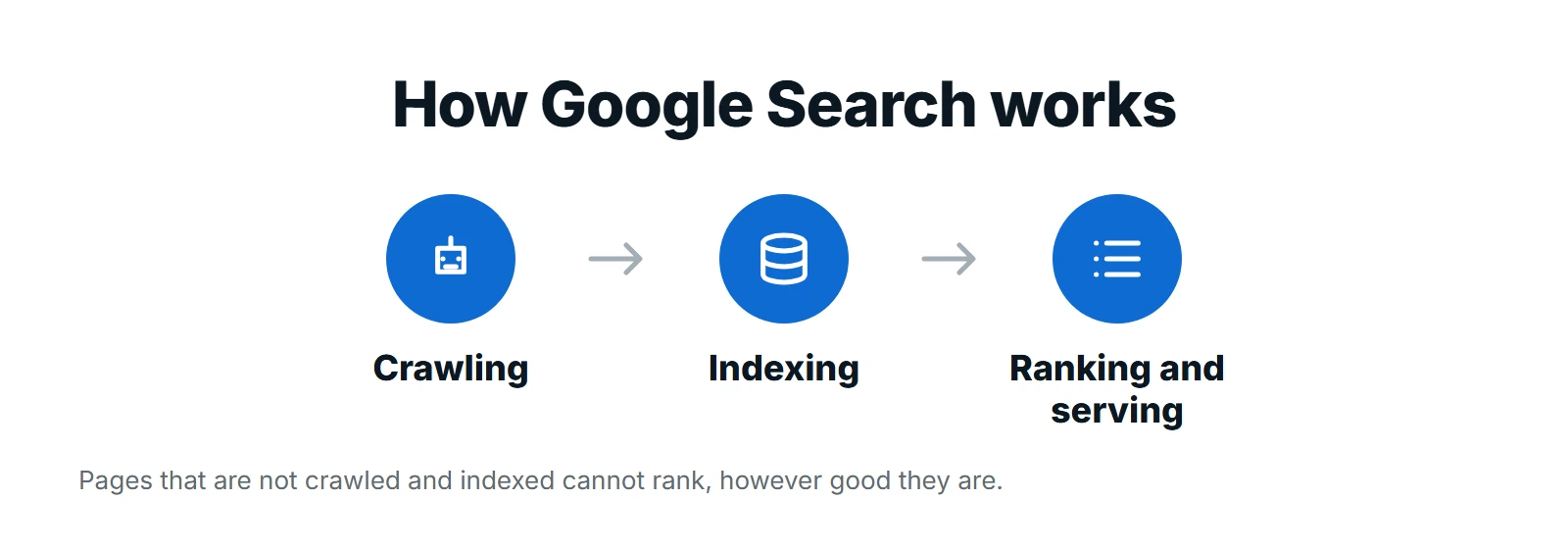
Google explains the process in its guide to how Search works:
- Crawling: Googlebot discovers pages by following links and reading sitemaps, then downloads them. Pages blocked by robots.txt, or with no links pointing to them, may never be found.
- Indexing: Google analyses the page’s text, images and structure, decides whether it is a duplicate, picks the canonical version, and stores it. Not every crawled page is indexed; low-value or duplicate pages are often left out.
- Ranking and serving: when someone searches, Google’s systems pick the most relevant, useful indexed pages for that searcher, taking location, language and device into account.
If a page is not indexed, nothing else matters. Search Console’s Page indexing report shows which of your pages are indexed and why others are not, which is why a technical SEO check is always the first step.
How ranking actually works
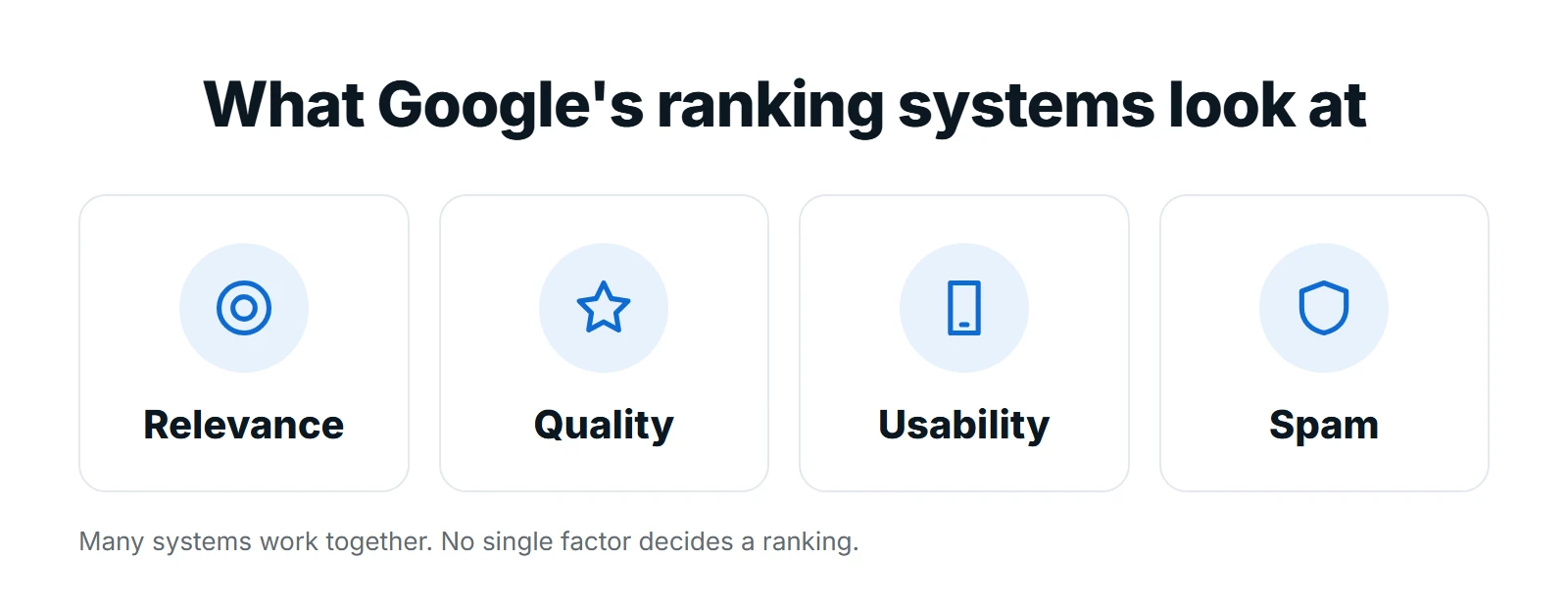
Google publishes a guide to its ranking systems. It names systems such as BERT and neural matching (understanding what words mean in context), link analysis and PageRank (how pages link to each other), freshness systems (newer content for searches that need it), the reviews system (rewarding in-depth, first-hand reviews), site diversity (usually no more than two results from the same site at the top), and spam detection. They broadly fall into four groups.
| Group | What Google looks at | What you can do |
|---|---|---|
| Relevance | Whether the page matches the meaning and intent of the search | Answer the question directly and use the words your customers use |
| Quality | Expertise, experience, original value and reliable information | Show real experience, cite sources, keep facts current |
| Usability | Page experience, mobile use, speed and safety | Fast, readable pages without intrusive pop-ups |
| Spam | Attempts to manipulate rankings | Follow Google’s spam policies; never buy links or mass-produce pages |
What quality means to Google
Google’s guidance on helpful, reliable, people-first content asks questions such as: Does the content provide original information? Does it show first-hand experience? Would you trust it? Google’s human search quality raters use the same ideas, known as E-E-A-T (experience, expertise, authoritativeness and trust), described in its rater guidelines. Raters do not change rankings directly; their feedback helps Google check whether its systems are working.
Core updates and spam updates
Google changes Search thousands of times a year, but two kinds of announced update matter most. Core updates retune the main ranking systems and can move rankings across all kinds of sites. Spam updates improve the systems that detect violations of Google’s spam policies. Our post on when the next Google core update is likely tracks the timing, and our guide to the March 2026 core update shows how to check whether an update affected you.
How AI Overviews and AI Mode fit in
Google’s AI features in Search draw on the same index and core ranking systems. Google’s guidance on AI features and your website says there are no special requirements to appear in them beyond normal SEO best practice: be crawlable and indexable, and publish helpful content. Clear, well-structured pages that answer questions directly are the ones most easily used. Our AI visibility work builds on that same foundation.
Ranking myths you can ignore
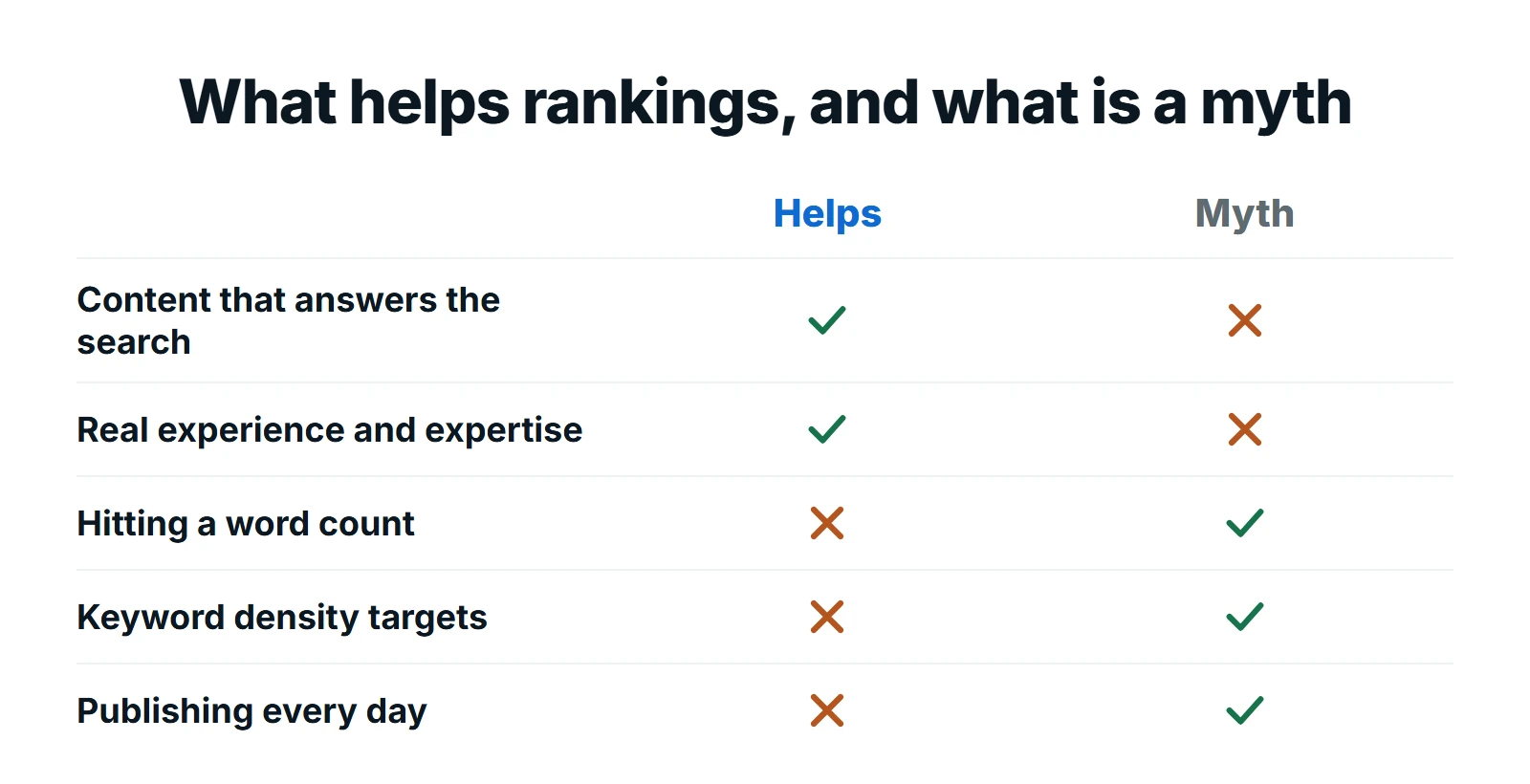
Google has repeatedly said that some simple, easy-to-measure factors are not ranking signals. Chasing them wastes time:
- Word count. A page should be as long as it needs to be to answer the search well.
- Keyword density. Use the words naturally; repeating them more does not help and can hurt.
- Publishing frequency. Posting more often does not raise rankings by itself; quality per page does.
- Exact-match domains. Google has a system that stops low-quality sites ranking just because their domain matches a search.
- Meta keywords. Google ignores the meta keywords tag.
What to focus on
- Make sure your important pages are crawled and indexed.
- Give each page one clear purpose and answer the searcher’s question early.
- Show real experience: examples, photos, data and named authors.
- Keep pages fast, mobile-friendly and free of intrusive interruptions.
- Earn links and mentions by being worth citing, not by buying them.
- Merge or remove thin, duplicate and outdated pages.
Want help putting this into practice? Our SEO services start with exactly these foundations. Request a free proposal.
Frequently asked questions
How many ranking factors does Google use?
Google does not publish a number. Its ranking systems use many signals together, and the weight of each depends on the search. Focus on relevance, quality and usability rather than individual factors.
How often does Google change its algorithm?
Google makes thousands of changes to Search every year. Only some are announced, mainly core updates and spam updates, which are listed on the Google Search Status Dashboard.
Does Google penalize AI-written content?
Google rewards helpful content however it is produced, but using automation mainly to manipulate rankings breaks its spam policies on scaled content. Content needs real value and human oversight.
Is the helpful content update still separate?
No. Google folded its helpful content system into its core ranking systems in March 2024, so helpfulness is now assessed as part of core ranking and core updates.