- Google released the September 2026 spam update on September 24 and said the rollout may take up to two weeks.
- Search Console added a multimodal search type filter on September 24, covering Lens, Circle to Search, image uploads and Chrome’s “Search this image”.
- Google’s John Mueller warned that low-value programmatic SEO can make Google’s systems lose faith in a site.
- Google’s page experience documentation now points to experimental CrUX ad metrics, though Google says not everything is a direct ranking factor.
- Google Maps now asks people to sign in to read all reviews on a Business Profile, according to Search Engine Roundtable.
September 2026 ended with Google’s third spam update in three months, and this one was given a much longer rollout window than the last two. Around it came new data on image searches, a blunt warning about mass-produced pages and changes that local businesses will notice on Google Maps.
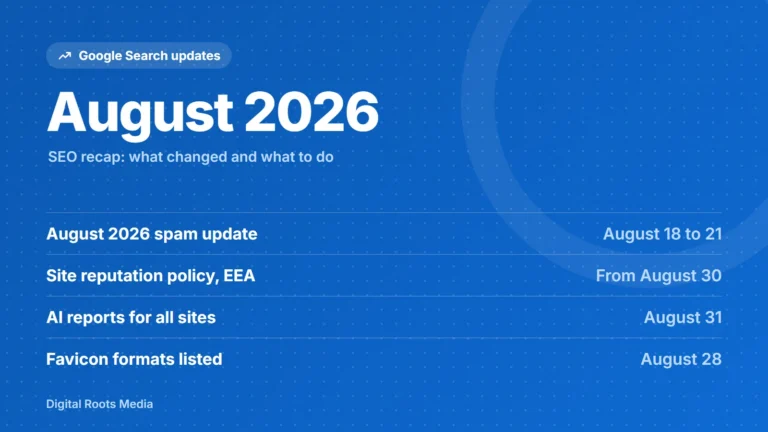
Here is what Google confirmed in September 2026 and what to do about it. For the previous month, see our August 2026 SEO updates recap.
Share your website. We will send a free audit and a fixed-price plan built around your goals.
- Free website audit
- Fixed-price plan
- No obligation
September 2026 at a Glance
- Around September 4, September 15 and September 23 to 24: Unconfirmed ranking volatility is reported.
- September 7: John Mueller’s warning about low-value programmatic SEO is reported.
- September 8: Google documents regional differences in the Search experience.
- September 14: Google’s AI contribution pilot for publishers is reported.
- September 16: Google adds documentation for a Search profile badge.
- September 22: Google’s page experience docs are reported to reference experimental CrUX ad metrics.
- September 24: The September 2026 spam update begins. Search Console adds multimodal search data. VideoObject markup gains the creator property.
- September 30: A Google Maps sign-in requirement for reading all reviews is reported.
1. The September 2026 Spam Update
Google released the September 2026 spam update at 9:15 AM Pacific on September 24, 2026: “Released the September 2026 spam update, which applies globally and to all languages. The rollout may take up to two weeks to complete.”
The rollout window is the notable part. Google said the June and August spam updates would each take a few days, and both finished within three. This time Google allowed up to two weeks. Search Engine Roundtable reported a big impact over the first weekend of the rollout.
Update: Google confirmed on its Search Status Dashboard that the rollout was complete as of October 8, 2026, two weeks after it began.
What to do
- Wait for completion before drawing conclusions, then compare your Search Console data from before September 24 with the days after the rollout ends.
- Check Manual actions in Search Console.
- Review the spam policies, especially scaled content abuse, site reputation abuse, expired domain abuse and link spam.
- Fix, then be patient. Google says improvements can take months to show, as its systems learn that a site complies with its policies.
This is the third spam update since June. If your site relies on any shortcut, now is the time to remove it.
2. Search Console Now Shows Image and Camera Searches
On September 24, Google announced Search Console reporting for web multimodal search, in both the Search results Performance report and the Generative AI report. A new multimodal search type filter shows how your content appears when people search with images, including:
- Google Lens
- Circle to Search on Android
- Image uploads to Google Search
- Chrome’s right-click “Search this image” feature
The data is rolling out globally and appears if your site receives traffic from these searches. You can export it like any other Performance data.
This matters for any business with something visual to show: stores, restaurants, home services with project photos, real estate. People point their camera at something and search. Make sure your product and project images are original, sharp, well named and described with alt text. Our image optimization guide covers the details.
3. Google’s Warning on Programmatic SEO
On September 7, Search Engine Roundtable reported a Bluesky post in which John Mueller responded to a site struggling with a large set of programmatically generated pages.
“Programmatic SEO like this often leads to a site that’s either spam, borderline spam, or low quality.”
He added that Google’s systems had “possibly lost faith in your site providing good value to users based on the old pages”, and that “It’s easy to spin something up with many pages, it’s hard to provide real value to users.”
This is directly relevant to service businesses. Dozens of near-identical city or service pages with only the location name swapped are the kind of content that can drag down a whole site. Every location page should earn its place with real local detail: projects completed there, local photos, specific service areas and reviews from customers in that area.
4. CrUX Ad Metrics in Google’s Page Experience Docs
Chrome’s User Experience Report (CrUX) added experimental ad metrics in September, and on September 22 Search Engine Roundtable reported that Google’s page experience documentation now references them. The four metrics are:
- Ad Count: the average number of ads in the viewport.
- Ad Density: the average share of the viewport covered by ads.
- Ad Weight (Network): the bytes ads consume.
- Ad Weight (CPU): the processing time ads consume.
Google’s documentation says these experimental metrics “can help you understand your site’s ad count, ad density, and ad weight metrics.” Asked whether they affect rankings, John Mueller replied: “Not everything is a direct search ranking factor!” Still, heavy ads slow pages and frustrate visitors, so if you run ads, review these numbers alongside your Core Web Vitals.
5. Video Markup Gains a Creator Property
On September 24, Google added the creator property, with support for author, to its VideoObject structured data documentation, and updated interactionStatistic to list the supported interaction types. If you publish video on your site, add who made it. It is a simple way to connect your videos with your brand and your experts.
6. Local Search: Maps Reviews and Search Profiles
- Sign-in to read all reviews. On September 30, Search Engine Roundtable reported that Google Maps now requires people to sign in to read the full set of reviews on a Business Profile, and to sort reviews or leave one. Signed-out visitors see less, so your rating and your most recent reviews carry even more weight. Keep reviews coming and reply to every one professionally.
- Search profile badge. On September 16, Google added documentation on adding a Search profile badge to your website, so you can point your audience to your Search profile.
- Regional differences. On September 8, Google documented how the Search experience differs in certain countries, such as aggregator units, supplier units and carousels. On September 18, those units gained support for local business queries.
Our Google Business Profile guide covers how to keep your profile competitive, and our local SEO team can manage it for you.
7. Google Pilots Paying Publishers for AI Use
On September 14, Search Engine Roundtable reported on Google’s AI contribution pilot, a small test that pays participating publishers when their content contributes significantly to AI-generated responses in the Gemini app, AI Overviews and AI Mode. Participants see an earnings widget in Search Console. According to Digiday, Google approached publishers directly and described the scheme as “an early-stage learning pilot to test how best to reward high-quality content”. It is a small invitation-based test, but it shows one direction Google may take.
We will review your website and show you exactly what is holding it back.
8. Your October Action Plan
- Note the September spam update end date, then compare before and after in Search Console
- Check Manual actions and review the spam policies
- Audit location and service pages and merge any that are near duplicates
- Use the multimodal search type filter to review your image search traffic
- If you run ads, review CrUX ad count and ad density
- Ask recent customers for Google reviews and reply to every one
9. Frequently Asked Questions
When did the September 2026 spam update start?
It started on September 24, 2026, at 9:15 AM Pacific. Google said the rollout may take up to two weeks. Update: Google confirmed the rollout was complete as of October 8, 2026.
Was there a core update in September 2026?
No. The only confirmed ranking update in September 2026 was the September 2026 spam update. The most recent core update was the May 2026 core update, which finished on June 2.
What is multimodal search in Search Console?
It is a new search type filter in the Performance reports. It shows how your content performs when people search with images, including Google Lens, Circle to Search, image uploads and Chrome’s “Search this image”.
Is programmatic SEO against Google’s rules?
Creating many pages is not a violation by itself, but pages produced at scale mainly to rank, with little value for readers, can fall under Google’s scaled content abuse policy. Google’s John Mueller said programmatic SEO often leads to a site that is spam, borderline spam or low quality.
Are CrUX ad metrics a ranking factor?
Google has not said they are. When asked, John Mueller replied that not everything is a direct search ranking factor. They are useful for understanding how ads affect your visitors’ experience.
Final Thoughts
Three spam updates in three months send a clear message: shortcuts are getting more expensive. At the same time, Google keeps giving honest sites better data, from AI visibility to image searches. The winning approach has not changed. Build fewer, better pages, show real proof and make every visit worth the click.
At Digital Roots Media, our SEO and technical SEO teams help businesses grow through every update. Request a free website audit and we will show you what to fix first.