- Google has not announced its next core update. The last one, the May 2026 core update, started on May 21, 141 days before this post.
- In our analysis of every update on Google’s Search Status Dashboard since November 2021, the median gap between core updates is 109 days. The current gap is already longer than 10 of the last 15.
- A core update started between October and December in four of the last five years.
- On October 1, 2026, Google rewrote its helpful content guidance: it now defines “main content”, lists four quality attributes and calls fake author profiles a form of deception.
- The best preparation is the same with or without a date: record a baseline now and fix pages that would fail Google’s new quality attributes.
Every SEO professional is asking the same question this month: when is the next Google core update, and what will it hit? Google has been unusually busy. It has run three spam updates since June, the last one a two-week rollout that finished on October 8, and on October 1 it quietly rewrote one of its most important pages of guidance for site owners.
On October 5, Search Engine Journal’s Roger Montti wrote that Google may release a major core update before the holiday season, and several well-known SEOs have said the same. Instead of adding another opinion, we went to the source. We pulled every ranking update Google has logged on its Search Status Dashboard since November 2021, measured the patterns, and compared Google’s guidance page before and after the October change.
Here is what the data shows, what Google actually changed, what is still speculation, and what you should do now so the next core update helps your site rather than hurts it.
1. Where Things Stand on October 9, 2026
Google has not announced a core update since May. Here is the confirmed timeline from Google’s Search Status Dashboard since then:
- May 21 to June 2: the May 2026 core update, the second core update of the year.
- June 24 to 26: the June 2026 spam update.
- August 18 to 21: the August 2026 spam update.
- September 24 to October 8: the September 2026 spam update, which Google said could take up to two weeks, and did.
Alongside those updates, Google changed two documentation pages on October 1: its guide to using generative AI content, and its main guide to creating helpful, reliable, people-first content. We cover both in section 3.
If you missed the details of the recent updates, our September 2026 SEO updates recap and May 2026 core update recap cover them.
2. What 5 Years of Google Update Data Tells Us
Google’s Search Status Dashboard keeps a public record of every confirmed ranking update, with start dates and rollout times, going back to November 2021. We charted all of it.

Core updates arrive roughly every three to four months
There have been 16 core updates in that window. Measured from the start of one to the start of the next, the median gap is 109 days and the average is 110 days. The shortest gap was 28 days, between the October and November 2023 updates. The longest was 189 days, from November 2021 to May 2022.
As of October 9, 141 days have passed since the May 2026 core update started. That is longer than 10 of the 15 previous gaps, but five gaps were longer still, so the wait is not unusual on its own.

The fourth quarter is a busy time for core updates
A core update started between October and December in 2021 (November), 2023 (October and November), 2024 (November and December) and 2025 (December). The one exception was 2022, when the last core update came in September. That is four of the last five years, and it is the pattern behind the talk of a pre-holiday update.
Spam updates are not a reliable warning sign
One popular theory is that spam updates “clear the table” before a core update. The data gives that theory only partial support. Of the 12 spam updates since November 2021, a core update started within 14 days in four cases: November 2021 (14 days later), October 2023 (one day), March 2024 (the same day) and March 2026 (three days). In the other eight, the next core update came 56 days or more later, or has not come at all.
What is genuinely unusual is the number. 2026 has already had four spam updates, more than any other year in the dashboard’s history.

What the data cannot tell you
Patterns are not announcements. Google does not publish a schedule, and it lists core updates when they start, not before. History says a core update before the end of 2026 is likely, but anyone who gives you an exact date is guessing. The more useful question is what Google will be looking for, and on that point Google has just told us a lot.
3. Google Rewrote Its Helpful Content Guidance on October 1
Google’s page Creating helpful, reliable, people-first content is the closest thing site owners have to a description of what core updates reward. On October 1, 2026, Google added several new sections to it. We confirmed the timing with the Internet Archive: a copy from October 1 at 15:48 UTC does not have them, while a copy from October 2 does.
Here is what changed, in plain English.
Google now defines “main content”
Google’s guidance now says that one of the most critical factors for assessing page quality is the quality of the main content, and it defines main content as “any part of the web page that directly helps the page achieve its purpose.” That covers far more than the words on the page:
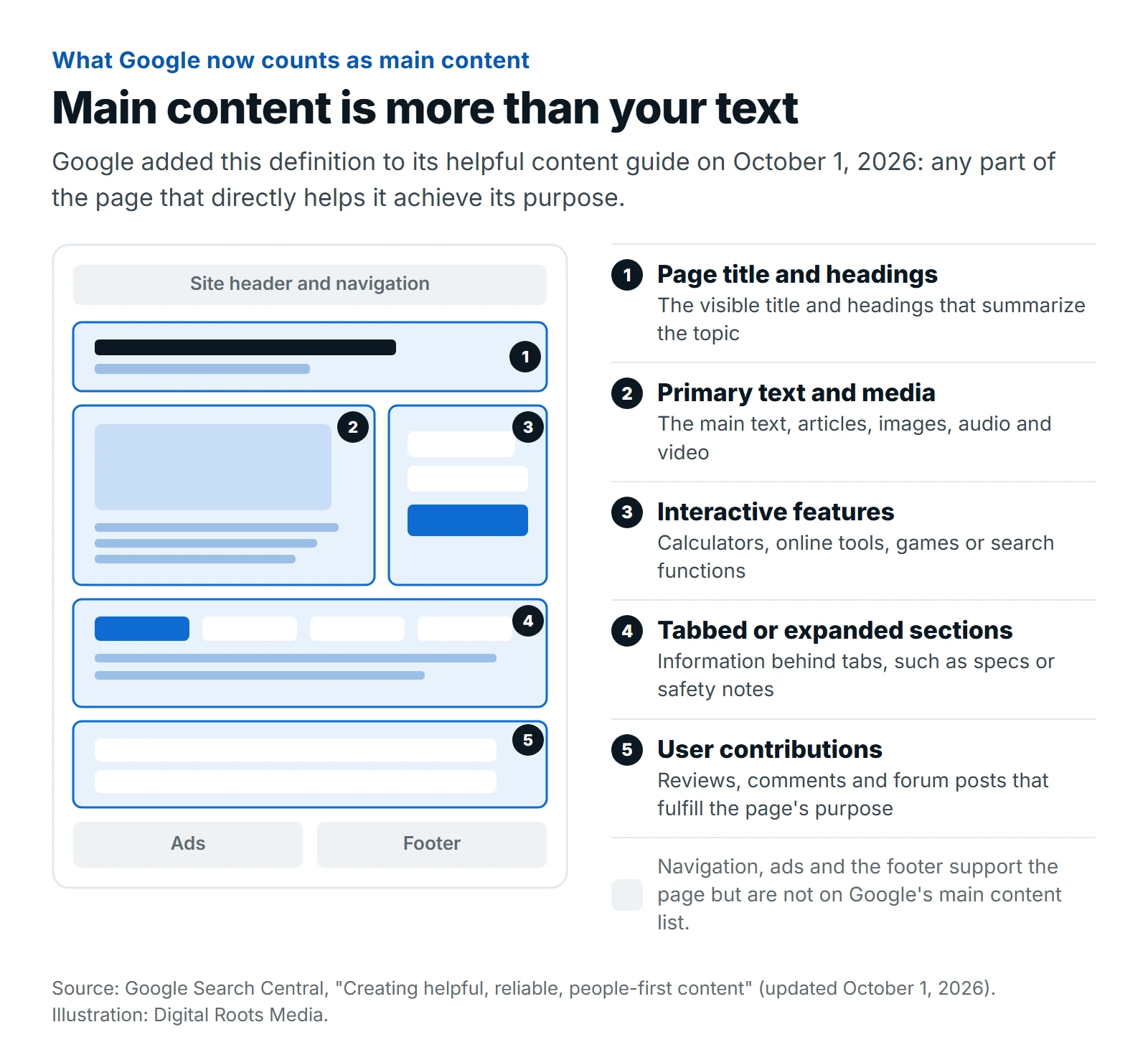
- Primary text and media: the main text, articles, images, audio and video.
- Interactive features: calculators, online tools, games or search functions.
- User-generated contributions: forum discussions, reviews, comments or uploaded media, when they directly fulfill the page’s purpose.
- Tabbed or expanded sections: information behind tabs, such as specifications or safety notes.
- Page titles and headings: the visible title and headings that summarize the topic and help people decide whether to visit.
For business websites, this matters in two ways. Tools such as cost calculators, quote estimators and booking widgets count as main content, so a useful tool adds to your page’s quality. And your titles and headings are described by what they do for readers, summarizing the topic, not by how many keywords they hold.
Four attributes Google’s raters look for
The guidance also lists the attributes Google’s search quality raters are trained to evaluate when they judge main content:

- Effort: how much human work went into the content or the systems behind it. Google’s examples of little to no effort include generating pages automatically from feeds and using generative AI to produce large amounts of text without manual oversight. It also notes that crediting other sources does not replace original effort.
- Originality: unique information or perspectives that are not already available on other websites.
- Talent or skill: the skill needed to give visitors a satisfying experience, such as clear writing, well-produced video or page tools that work.
- Accuracy: informational pages should be factually accurate, and health, money and safety topics must be highly accurate and consistent with expert consensus.
One caution before you read too much into this. Google’s own page says raters have no control over how pages rank and that “Rater data is not used directly in our ranking algorithms.” Raters help Google check whether its systems are working. But the attributes describe what those systems are designed to reward, which is why this change is worth taking seriously.
Fake authors are now called deception
Google has long encouraged bylines. The new guidance adds a clear warning: “Fabricating creator profiles (such as by using AI-generated headshots, made-up names, or false credentials to make content appear as if it was written by human experts) is a form of deception.” Google says any form of deception makes a page untrustworthy to users and to its automated quality systems, and is a signal of a low-quality page.
If your blog uses invented “expert” personas or stock headshots for writers who do not exist, fix that before anything else. A real name, or an honest team byline, is always safer than a made-up expert.
AI content: fact-check everything, including metadata
On the same day, Google updated its guidance on using generative AI content. It now points site owners to the sections of the Search Quality Rater Guidelines on scaled content abuse (section 4.6.5) and on main content made with little effort, originality or added value (section 4.6.6). It also explains why fact-checking is essential: generative models “don’t retrieve facts, but predict a likely sequence of words based on their training data.”
Google says that review applies to more than the article. Title elements, meta descriptions, structured data and image alt text can all appear in search results, so they need the same check.
Our guide to AI content and Google covers where Google draws the line.
4. What This Could Mean for the Next Core Update
Google has not said what the next core update will change, so this section is our analysis, not a confirmation.
Google usually updates its guidance to describe what its systems already look for. Taken together with 2026’s record number of spam updates, the October changes point in one direction: Google is focused on content made at scale without real effort, and on trust signals such as honest authorship and accurate information. Search Engine Journal’s article reaches a similar view, and SEO consultant Lily Ray summed up the mood on X: “All signs point to a major Google update on the horizon.”
In September, Google’s John Mueller gave a blunt answer about sites built from large numbers of automatically generated pages:
“It’s easy to spin something up with many pages, it’s hard to provide real value to users.”
If that describes part of your site, the next core update is a good deadline for dealing with it.
5. How to Prepare Your Site Now
You cannot control when the update arrives, but you can control how ready your pages are and how quickly you will understand what happened.
Record a baseline before anything moves
Export the last three months of Search Console performance data for your most important pages and queries, and add an annotation for today. When the update arrives, you will be able to compare a clean before and after, which is what Google recommends once a rollout is complete.
Audit your top pages against the four attributes
Take your 20 most important pages and ask four questions about each one:
- Effort: did a person do real work here, or could this page have been generated in minutes?
- Originality: what does this page say that the top five results do not?
- Talent or skill: is it clearly written and well designed, and do its tools work?
- Accuracy: are the facts, prices and claims correct and current?
Pages that fail two or more of those questions are your priority list.
Make authorship real
Use real names and real experience. If a page is written by a team, say so. Never use AI-generated headshots or credentials nobody holds.
Give pages something original
Add what only you can add: photos of your own work, real project examples, data from your own business, a useful calculator, answers to the questions your customers actually ask. That is what Google means by non-commodity content.
Rewrite titles and headings for people
A heading should tell a reader what the section covers. If your headings read like keyword lists, rewrite them to summarize the content honestly.
Merge thin and near-duplicate pages
Location pages with only the city name changed, or blog posts that repeat each other, are the kind of low-effort content the new guidance describes. Combine them into fewer, stronger pages and redirect the old URLs. Our technical SEO audit guide explains how to find them.
Check reviews and comments
User contributions can count as main content when they serve the page. Moderate spam, answer real questions and keep reviews genuine. Our guide to getting more Google reviews covers honest ways to grow them.
- Export three months of Search Console data and annotate today’s date
- Score your top 20 pages on effort, originality, talent or skill, and accuracy
- Replace any invented author profiles with real names or an honest team byline
- Add original photos, examples, data or tools to your weakest important pages
- Rewrite headings that read like keyword lists
- Fact-check AI-assisted content, including titles, meta descriptions, schema and alt text
- Merge thin or near-duplicate pages and redirect the old URLs
6. What Not to Do
- Do not rewrite everything at once. Google’s core update guidance recommends against changing content that is already performing well. Focus on the weak pages.
- Do not react mid-rollout. Wait until Google marks the update complete, then wait one more week before analyzing, as Google advises.
- Do not chase volatility trackers. Third-party tools often report swings that Google never confirms. Your own Search Console data is what counts.
- Do not buy links or AI “mentions”. Google’s spam policies cover both, and 2026 has shown how often spam updates now arrive.
- Do not mass-delete content in a panic. Improve or consolidate first. Deleting pages that earn links or traffic can make things worse.
7. Frequently Asked Questions
When is the next Google core update?
Google has not announced it. Based on every core update since November 2021, the median gap between updates is 109 days, and a core update has started between October and December in four of the last five years. History suggests one before the end of 2026 is likely, but Google has not confirmed a date.
Does Google announce core updates in advance?
No. Google posts core updates on its Search Status Dashboard when they start rolling out, then posts again when the rollout is complete.
How long does a Google core update take?
Usually about two weeks. Across the 16 core updates since November 2021, the median rollout took about 14 and a half days. The shortest took about six days (December 2024) and the longest took 45 days (March 2024). The May 2026 core update took about 12 days.
Is a spam update a sign that a core update is coming?
Not reliably. Of the 12 spam updates since November 2021, a core update started within two weeks in four cases. In the other eight, the next core update came much later or has not happened yet.
Will the next core update target AI content?
Google has not said. Its guidance does not ban AI content, but its October 2026 changes describe mass-produced text without oversight as low effort and stress fact-checking. AI-assisted content that is edited, original and accurate is very different from pages generated at scale.
Should I change my site before the update?
Improve weak pages now, because better pages help whenever the update arrives. Avoid large changes to pages that already perform well, and avoid reacting while a rollout is still in progress.
Final Thoughts
Nobody outside Google knows the date of the next core update. What we do know is what Google has told us to focus on, in writing, eight days ago: real effort, original information, skilled presentation, accurate facts and honest authorship. Sites that already deliver those things tend to come through core updates well. Sites that do not still have time to catch up, and the best time to start is before rankings move.
At Digital Roots Media, our SEO team helps businesses prepare for every update with audits grounded in Google’s own guidance. Request a free website audit and we will show you which pages need attention first.
Sources
- Google Search Status Dashboard: ranking update history
- Google Search Central: Creating helpful, reliable, people-first content
- Google Search Central: Guidance on using generative AI content
- Google Search Central: Latest documentation updates
- Google Search Central: Google Search’s core updates and your website
- Google Search Central: Spam policies for Google web search
- Internet Archive: helpful content page, October 1, 2026
- Internet Archive: helpful content page, October 2, 2026
- Search Engine Journal: What to expect from Google’s next search ranking update